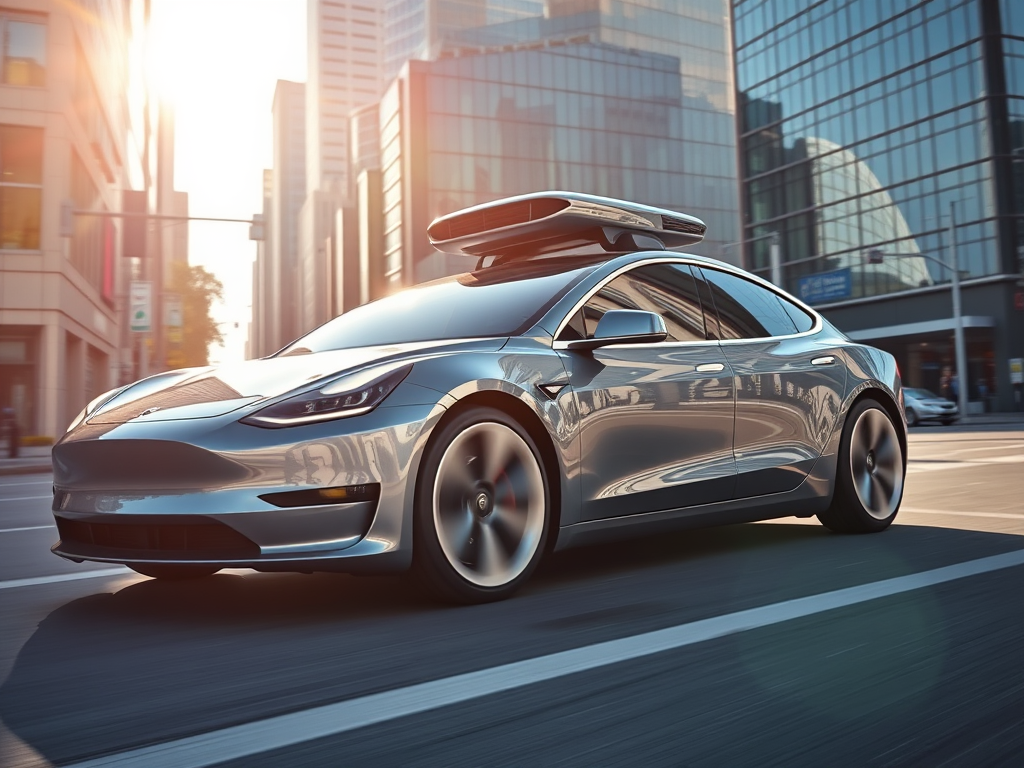
When you hear the name Tesla, one of the first things that likely comes to mind is self-driving cars. But have you ever wondered what really powers Tesla’s groundbreaking autonomous technology? The answer lies in artificial intelligence (AI) — the driving force behind Tesla’s ability to navigate, react, and learn from the world around it.
In this post, we’ll break down how Tesla uses AI in their cars, explain how self-driving tech works, and explore the future of autonomous driving.
What Is Tesla’s Self-Driving AI?
Tesla’s self-driving capabilities are built on a sophisticated system called the Full Self-Driving (FSD) suite, which combines neural networks, machine learning, real-time data, and massive computing power. The core of this system is Tesla’s Autopilot AI, which processes data from multiple cameras and sensors to make intelligent driving decisions.
Key Components of Tesla’s AI System
Let’s explore the core technologies that enable Tesla to achieve semi-autonomous and, eventually, full autonomous driving.
🚘 1. Neural Networks
Tesla uses deep neural networks (DNNs) — a form of machine learning inspired by the human brain — to train its cars to “see” and “understand” the environment.
How it works:
- Neural nets process input from Tesla’s 8 external cameras, ultrasonic sensors, and radar (in older models).
- These networks learn to detect road signs, lane markings, pedestrians, cyclists, and other vehicles.
- Over time, the model gets better through a process called supervised learning.
Fun Fact: Tesla’s neural networks are trained on over 1 billion miles of real-world driving data from its fleet.
🔋 2. Tesla’s Full Self-Driving Computer (FSD Chip)
Every new Tesla includes the company’s custom-designed FSD computer, also known as Hardware 3.
Key features:
- Capable of 144 trillion operations per second
- Built specifically to run Tesla’s AI models in real time
- Replaces the need for third-party processors like NVIDIA
This chip allows the vehicle to process massive amounts of visual and spatial data quickly and safely.
🧠 3. Vision-Based AI (No Lidar)
Unlike competitors, Tesla relies on vision-only AI, meaning it doesn’t use lidar or expensive 3D sensors.
Why it matters:
- Tesla believes that a vision-based system, just like human drivers use their eyes, is enough to achieve full autonomy.
- The 8-camera setup provides 360° visibility and real-time depth perception.
AI interprets this visual data to detect lanes, objects, distances, and movements — even in rain, fog, or nighttime driving.
🌍 4. Real-Time Decision Making
Tesla’s AI continuously processes data while driving to:
- Recognize stop signs, traffic lights, and road hazards
- Make lane changes and take highway exits
- Respond to pedestrians or erratic drivers
- Navigate roundabouts, tight corners, and construction zones
This real-time decision-making capability is the core of Tesla’s Autopilot and FSD Beta programs.
Autopilot vs Full Self-Driving (FSD): What’s the Difference?
Many people confuse Tesla’s Autopilot with Full Self-Driving, but they offer different levels of AI automation.
✅ Autopilot (Standard)
- Included with every Tesla
- Adaptive cruise control
- Lane centering on highways
- Limited AI functionality
🚀 Full Self-Driving (FSD) – Paid Upgrade
- Navigate on Autopilot (including highway interchanges)
- Auto lane changes
- Smart Summon (car comes to you in a parking lot)
- Traffic light and stop sign control
- Autopark
- FSD Beta: Enables city street driving with AI decision-making
Note: As of 2024, Tesla’s FSD still requires driver supervision and is considered Level 2 autonomy.
How Tesla Trains Its AI (Fleet Learning)
One of Tesla’s biggest advantages is its fleet learning system.
How it works:
- Every Tesla on the road collects data on driving behavior, road conditions, and edge cases (rare scenarios).
- This data is sent back to Tesla’s servers (with user consent).
- Tesla uses it to train and refine their AI models.
The more Teslas drive, the smarter the system gets — creating a self-improving, global neural network.
Tesla Dojo: The Supercomputer Behind the AI
To support its growing AI models, Tesla built Dojo, a custom-built AI supercomputer designed to train its neural networks faster and more efficiently.
Highlights of Dojo:
- Processes exabytes of video data from Tesla’s fleet
- Trains computer vision systems for improved perception
- Enables faster rollout of updates and safety improvements
Dojo is critical for scaling Tesla’s autonomous tech across millions of vehicles worldwide.
Real-World Applications of Tesla’s AI
Tesla’s AI is already making driving safer and more convenient:
- Automatic emergency braking
- Lane-keeping assist
- Traffic-aware cruise control
- Smart Summon for parking lots
- Beta testing autonomous city driving
With frequent over-the-air updates, Tesla’s AI continues to evolve even after you’ve bought the car.
Challenges and the Road Ahead
While Tesla’s AI is powerful, there are still challenges to overcome:
- Regulatory approval for full autonomy
- Handling unpredictable human behavior
- Safety concerns in complex environments
However, with each software update, Tesla gets closer to achieving Level 4 or 5 self-driving, where no human intervention is needed.
Final Thoughts
Tesla is not just building electric cars — it’s building AI-powered robots on wheels. With its unique approach to vision-based AI, fleet learning, and dedicated supercomputing, Tesla is leading the charge in autonomous vehicle innovation.
Whether you’re a tech lover or a future EV owner, understanding how Tesla uses AI gives you a glimpse into the future of mobility — one where cars are smarter, safer, and fully self-driving.
Leave a Reply